Terrain-aware timing for hip exoskeleton assistance
The Chinese University of Hong Kong
The Hong Kong University of Science and Technology (Guangzhou)
Background
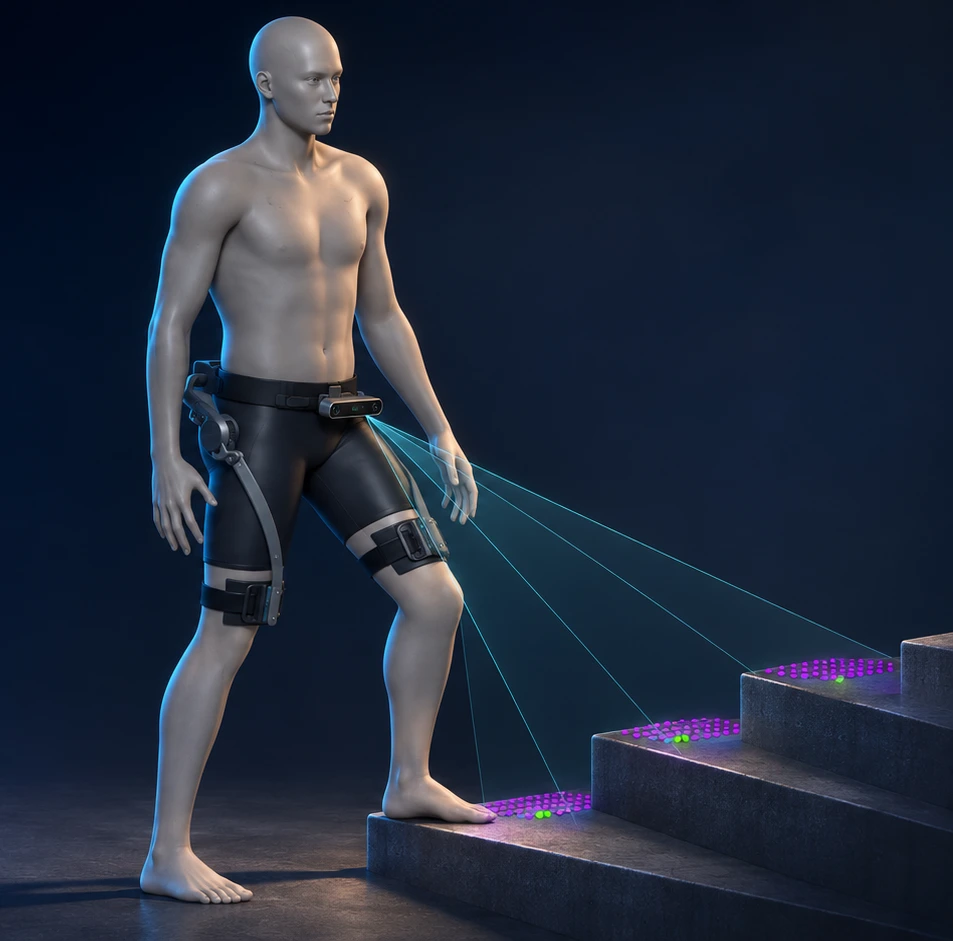
Wearable sensors can estimate joint loading and support assistance across a wide range of activities. Depth sensing adds information about the terrain before the wearer reaches it. The first step onto a stair remains a difficult case because the same step edge can be visible whether the person is about to climb, slow down or stop. We study how to use advance information about the terrain while timing assistance to the wearer’s movement. Molinaro et al., Nature (2024). Tricomi et al., IEEE Transactions on Robotics (2025).
Approach
We developed a hip exoskeleton research prototype with a waist-mounted depth camera. Our controller uses the height profile ahead and recent motion at both hips to decide which mode of assistance is appropriate and when to issue the command. We tested the decision model on simulated changes in terrain and walking pace. In separate simulations, we used reinforcement learning to model muscle-driven gait and compared motor work across phases of the gait cycle.
Additional transition simulations
Findings
In held-out simulated sensor sequences, the controller issued more timely, terrain-appropriate commands and fewer commands during periods designated for waiting than a baseline using the same sensors. In a separate comparison at similar overall motor work, the depth-informed controller contributed more positive hip flexion work during the swing phase of gap crossing than the encoder-only controller. The overall difference in target-phase work across terrains was smaller.
The outdoor recordings show stair edges and changes in surface height reconstructed from wearable depth measurements.
Gait simulations
Musculoskeletal simulations
Controller and gait training in simulation
Field recordings

Competition recognition
Evolution Tech received Second Prize in the Algorithm Track at the 2026 University Exoskeleton Robotics Maker Challenge in Guangzhou.
Publication
A manuscript is in preparation.